
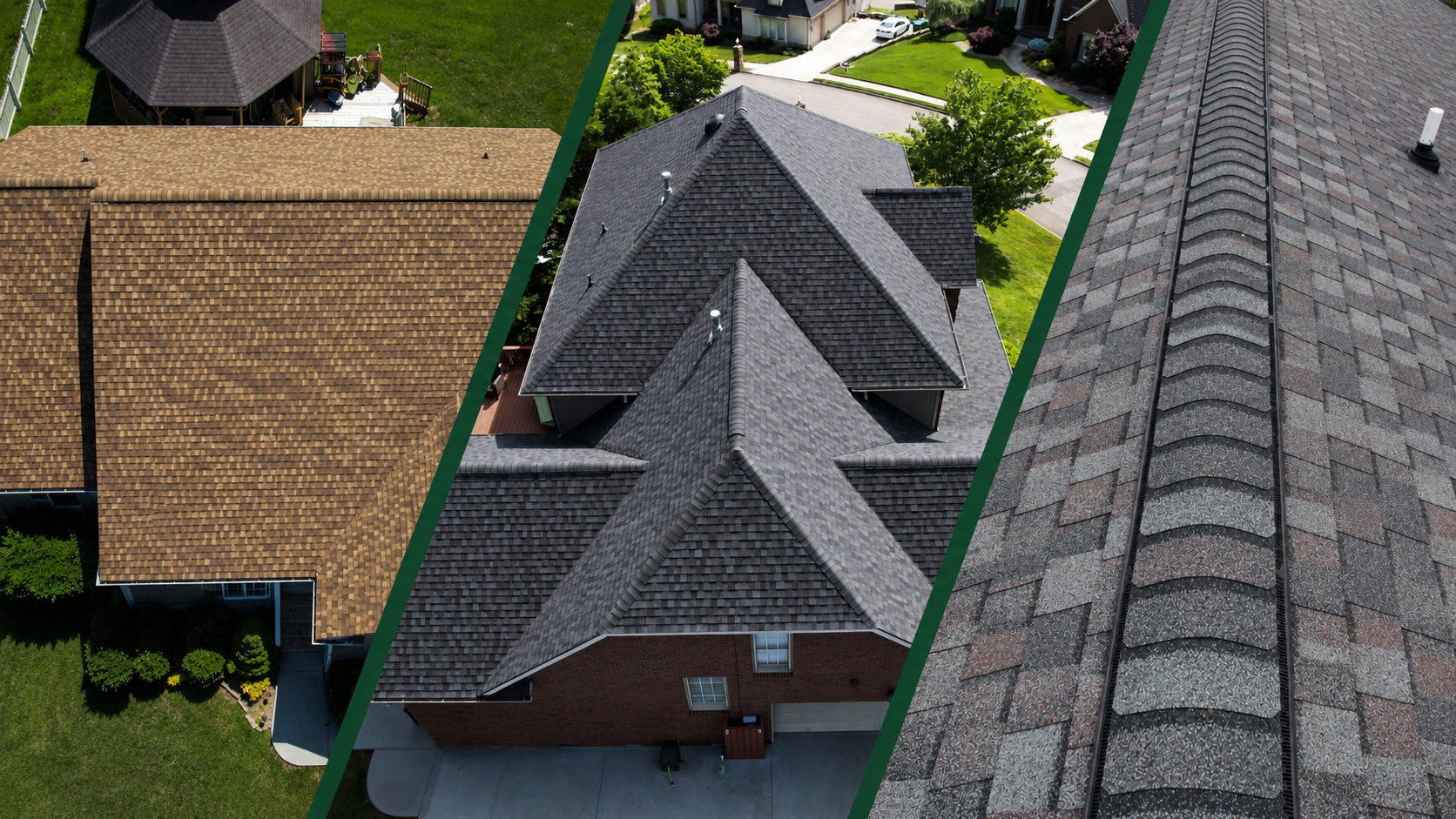
From the street, two asphalt roofs can look almost identical. Up close, the shingles may be very different products.
There are differences in thickness, layers, asphalt formulas, granules, adhesives, impact ratings, wind ratings, and warranty coverage. Even two shingles sold as architectural shingles can perform differently.
That is why we look beyond color when helping Knoxville homeowners choose an asphalt roofing system. The shingle you select affects how your roof looks, how it handles East Tennessee weather, and the protection that comes with it.
Asphalt Shingles Start With Similar Materials
Most modern asphalt shingles begin with a fiberglass mat. Asphalt surrounds that mat to provide waterproofing. Mineral granules cover the exposed surface.
Manufacturers then build on that basic formula in different ways. They may change the amount or formulation of the asphalt. Some add extra layers. Others reinforce certain parts of the shingle or use specialized granules.
These differences may be hard to spot once the shingles are installed. They can still affect performance.
Architectural Shingles Have Different Levels
One of the first distinctions among the different types of roofing shingles is their construction.
Traditional 3-tab roof shingles generally use a flatter, single-layer design. Architectural shingles are laminated. That creates more thickness and gives the roof a dimensional appearance.
But “architectural” describes a broad category. It does not mean every architectural shingle is built the same way.
CertainTeed Landmark, for example, uses dual-layer construction. Landmark PRO is a premium product within the same family with added asphalt content and a different color system. Other premium products can add more material or use different construction methods.
We install architectural or dimensional shingles rather than older 3-tab products. CertainTeed Landmark PRO and Owens Corning TruDefinition Duration are among the options homeowners commonly ask us about.
The Asphalt Formula Can Change
The asphalt itself can be different.
Some higher-performance shingles use polymer-modified asphalt. SBS is one example. It gives asphalt a more rubber-like flexibility.
Owens Corning Duration FLEX uses SBS-modified asphalt and carries a Class 4 impact rating. CertainTeed also uses polymer-modified asphalt in some of its ClimateFlex products.
Another shingle may reach a similar impact rating through a reinforced backing or another construction method. So even shingles carrying the same rating may be built differently underneath.
Wind And Impact Ratings Matter
For homeowners in Knoxville and across East Tennessee, storm performance deserves attention. Strong thunderstorms and hail occur throughout the region.
Impact-resistant asphalt shingles are commonly rated under UL 2218. Ratings range from Class 1 through Class 4. Class 4 represents the highest level under that laboratory test.
That does not make a Class 4 shingle hail-proof. It means the product passed a more demanding impact test.
Wind ratings vary too. Sealant strength, fastening, the nailing area, starter shingles, and ridge products can all affect wind performance.
For example, some manufacturers require specific roofing-system components before higher wind warranty coverage applies. This is one reason we recommend looking at the entire roof system instead of comparing one number on a shingle brochure.
Granules Affect More Than Color
Granules give an asphalt shingle roof much of its finished appearance. Manufacturers mix colors to create contrast, shadowing, and depth.
Those granules can have practical jobs too.
Some shingles include copper-containing granules that resist the dark streaking associated with algae. CertainTeed uses its StreakFighter technology for this purpose. Owens Corning has its StreakGuard system.
That can matter in East Tennessee, where shade and moisture can create good conditions for visible algae growth.
Other specialty shingles use reflective granules that reduce the amount of solar energy absorbed by the roof.
Warranty Coverage Can Be Very Different
A “limited lifetime warranty” sounds simple. The actual coverage can vary quite a bit.
You need to look at the initial coverage period, wind protection, algae coverage, transferability, and any installation requirements. Some upgraded warranties also depend on using a complete manufacturer-approved roofing system.
Our roofing warranty options can provide long-term material protection. Certain systems can also include workmanship coverage.
Contractor credentials matter here. As a CertainTeed SELECT ShingleMaster and Owens Corning Preferred Contractor, we can offer access to manufacturer warranty options that may not be available through every installer.
The Shingle Is Only Part Of The Roof
Even a high-rated shingle depends on the rest of the system.
Underlayment provides another layer of protection beneath the shingles. Starter shingles help resist wind uplift along the roof edge. Hip and ridge products protect roof peaks. Proper ventilation helps control heat and moisture in the attic.
Installation matters just as much.
As an experienced Knoxville roofing contractor, we look at the whole roof before recommending a product. You can also see what to expect from our process before your project begins.
Choosing The Right Asphalt Shingle
There is no single asphalt shingle that makes sense for every house. One homeowner may care most about impact resistance. Another may put more value on color, algae protection, warranty coverage, or budget.
We help you compare those differences instead of handing you a stack of samples and asking you to pick a color.
If you are considering a new roof in Knoxville or the surrounding East Tennessee area, contact Mountain View Exteriors. We can look at your home, explain the options, and help you choose a roofing system that fits what you actually need.