
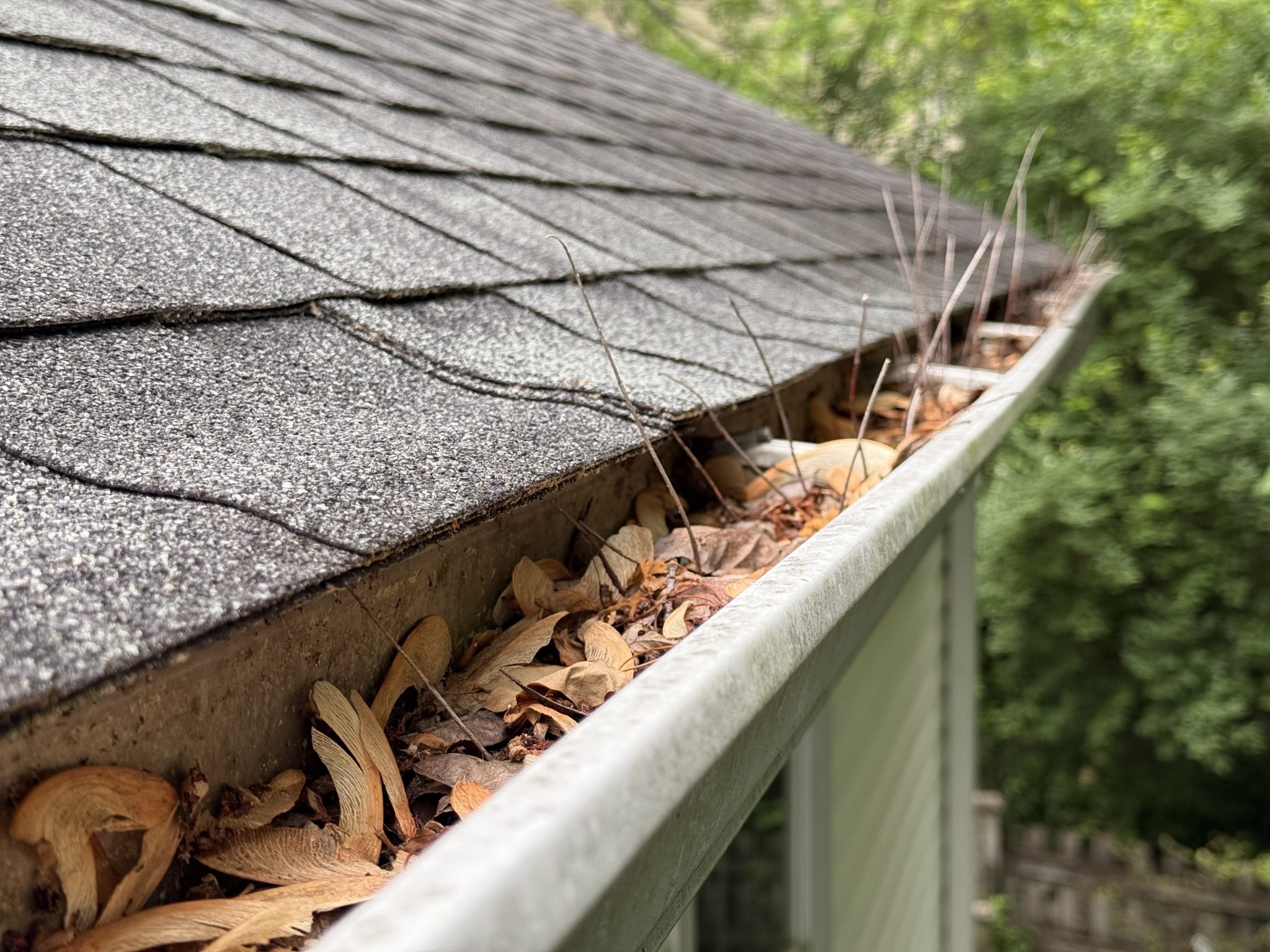
We see this most often around roof valleys and gutters. Those areas already handle a lot of water. When pollen collects there, it can slow runoff, hold moisture, and make existing weak spots easier to spot.
Why Pollen Matters On Knoxville Roofs
East Tennessee gets plenty of pollen. Tree pollen usually hits hard in spring, with oak, maple, cedar, and pine adding to the yellow film you see across your property. Grass pollen follows in warmer months. Weed pollen tends to show up later in the year.
On its own, pollen is light and powdery. The problem starts after rain.
Rain washes pollen down the roof. It collects in low points, roof valleys, inside gutter corners, and downspout openings. Then it mixes with whatever else is already there. That mix can become sticky, heavy, and slow to move.
A little pollen film is not usually a roof emergency. A thick layer of damp debris is different.
Why Roof Valleys Collect Pollen And Debris
Roof valleys are the channels where two roof slopes meet. They move water from both sides of the roof down into the gutter system. That means valleys handle more water than many other parts of the roof.
They also collect more debris.
Pollen can slide down the shingles and settle in the valley. So can leaves, pine needles, oak tassels, maple seeds, small twigs, and loose shingle granules. After a few rains, this can form a matted layer that sits right where water needs to flow.
That can cause a few problems:
- Water may move slower through the valley.
- Damp debris may keep shingles wet longer.
- Granules and grit may gather near the valley exit.
- Small issues with flashing may become easier to spot.
- Shaded valleys may stay damp after the rest of the roof dries.
This matters because valleys already see a lot of water. If the valley area is old, worn, or poorly draining, pollen buildup can make the problem more obvious.
How Pollen Can Lead To Clogged Gutters
Every roof valley eventually sends water into the gutter system. That makes gutters the next place to watch after heavy pollen season.
Pollen does not usually clog gutters by itself. It becomes a problem when it binds with dirt, roof grit, seed pods, and leaves. That sludge can settle inside gutter runs, especially near downspout outlets and inside corners.
That is where clogged gutters often begin.
You may see water spilling over the front edge during a storm. You may notice mulch washing out below the gutter. You might see water stains on the fascia, soffit, brick, or siding. Sometimes the gutter looks mostly clear from the ground, but fine debris is packed near the outlet.
Older or undersized gutters can struggle with this. Steep roof sections, long eaves, shaded lots, and multiple valleys can send a lot of water into one small area.
That is one reason we install six-inch seamless gutter installation with oversized 3×4 downspouts. Larger gutters can move more water than smaller systems. They also give debris more room to pass through instead of backing up near outlets.
Signs Pollen Buildup Is Becoming A Bigger Issue
You do not need to climb on your roof to notice warning signs. In fact, we would rather you stay safely on the ground. Roof walking can scuff shingles, loosen granules, or create damage that was not there before.
Look for these signs from a safe spot:
- Yellow-green buildup in roof valleys or gutter corners.
- Water spilling over gutters during rain.
- Damp-looking fascia or soffits.
- Dark streaks near valleys, eaves, or gutter lines.
- Soil erosion near the foundation.
- Gutters pulling away from the fascia.
- Shingles that look curled, lifted, stained, or missing.
If you notice several of these signs, a roof inspection can help you understand what is happening. Sometimes the issue is simple debris. Other times, the roof or gutter system is showing age.
What Pollen Can Reveal About Your Roof
Pollen buildup does not mean you need a roof replacement. It can, however, draw attention to weak areas.
If a valley stays damp for too long, moss and algae may become more likely, especially on shaded sections. Moss can lift shingle edges. Lifted edges can allow wind-driven rain to move where it should not go.
On an older asphalt roof, you may also notice heavy granule loss in the gutters. Some granule loss is normal over time. Large amounts can point to aging shingles. If your roof is already near the end of its life, spring pollen and rain may make drainage issues easier to see.
Our asphalt roof replacement options are a good fit for homeowners dealing with worn shingles, repeated leaks, or aging roof valleys. For homeowners interested in longer-lasting materials, our metal roof replacement optionsmay also be worth considering.
When Gutter Replacement Makes Sense
We do not offer gutter cleaning. We replace gutters and roofs.
That matters here because pollen buildup is often a cleaning issue at first. If your gutters are newer, properly sized, and firmly attached, cleaning may be all you need.
Gutter replacement makes more sense when the system keeps overflowing, pulling loose, leaking at seams, or struggling to move water during normal East Tennessee storms. It may also be time to replace gutters if the downspouts are too small for the amount of roof water they receive.
A good gutter installation should fit the roofline, the pitch, the valley layout, and the way water moves around your home. That is especially true for homes with heavy tree cover or several roof valleys.
A Good Time To Check Your Roof And Gutters
Late spring is a smart time to look things over. By then, much of the heavy tree pollen has already fallen, and spring rains have shown how well your valleys and gutters are moving water.
Fall matters too. Leaves and twigs can pile on top of pollen, grit, and sediment left behind from earlier in the year.
If you are seeing overflow, staining, sagging gutters, or roof wear, our team can help you sort out the next step. As a local roofing contractor in Knoxville, TN, we focus on honest guidance and replacement work that fits your home.
Keep Water Moving The Right Way
Pollen is part of life in Knoxville. The real issue is what happens after it washes into your roof valleys and gutters.
If it moves through, you are probably fine. If it sits, clumps, traps moisture, or causes overflow, it may be time to take a closer look. Schedule a free roofing estimate with Mountain View Exteriors, and we will help you decide if your roof or gutters are ready for replacement.